
Semantic SEO Services for SaaS

We build entity-driven SEO systems that make funded SaaS companies the authoritative answer wherever buyers and AI agents search, using structured data, knowledge graph optimization, and answer-ready content.
Search has fundamentally changed. Google's AI Overviews now appear in a third of searches. ChatGPT and Perplexity answer millions of buyer research queries daily. These AI systems don't rank keywords. They understand entities, relationships, and context.
What this means for SaaS companies:
When a buyer searches "best project management software for remote teams," AI search systems look for structured answers, not keyword density. They evaluate entity clarity (what is your product?), topical authority (are you an expert in project management?), and proof (do credible sources validate your claims?).
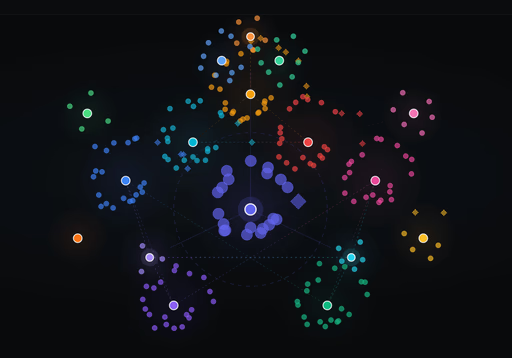
Traditional keyword SEO focuses on:
- Keyword research and targeting
- On-page optimization (title tags, meta descriptions)
- Backlink building
- Content volume
Semantic SEO for SaaS focuses on:
- Entity modeling (defining your product, features, use cases as structured entities)
- Knowledge graph optimization (connecting your entities to category concepts)
- Structured data implementation (JSON-LD schema for products, services, features)
- Answer-ready content (block-based content AI systems can extract and cite)
For funded SaaS companies competing for category leadership, semantic SEO is how you become the default answer in both traditional search and AI search platforms.
Our Semantic SEO Service for SaaS
Exalt Growth's Semantic SEO service transforms your website into an entity-driven growth engine optimized for Google, AI search platforms, and human buyers.
Entity Architecture & Knowledge Graph Optimization
We model your SaaS product as a network of entities (product, features, integrations, use cases, industries, problems solved) and map relationships between them. This creates topical authority that search engines and AI systems recognize.
Deliverables: Entity Graph, Topical Map, Relationship Diagram
Structured Data Implementation
We deploy JSON-LD schema markup across your site to explicitly communicate what your product is, who it serves, and what problems it solves. This includes Organization, Product, Service, SoftwareApplication, HowTo, FAQ, and Article schemas.
Deliverables: Schema Markup, Implementation Guide, Validation Reports
Block Factory: Answer-Ready Content System
We create modular content blocks (definitions, comparisons, feature explanations, FAQs, step-by-step guides) that AI systems can extract and cite. Each block is semantically clear, factually dense, and designed for both snippet extraction and LLM inclusion.
Deliverables: Block Library, Page Blueprints, Content Templates
AI Search Optimization
We optimize specifically for visibility in ChatGPT, Perplexity, Google AI Overviews, and similar platforms. This includes entity consistency across platforms, citation-worthy proof points, and prompt testing to validate AI visibility.
Deliverables: AI Visibility Baseline, Citation Tracking, Inclusion Reports
Revenue-Anchored Strategy
Every semantic optimization connects to pipeline outcomes. We track which entities drive demos, which content influences trials, and how topical authority impacts deal velocity.
Deliverables: Pipeline Attribution Reports, Conversion Analysis, ARR Impact Tracking
How We Deliver Semantic SEO for SaaS
Our Semantic SEO service is powered by the Exalt Growth Operating System (EGOS), a 12-module framework designed specifically for funded SaaS companies.
Discovery & Entity Modeling (Weeks 1-2)
We start by understanding your product, customers, and category positioning. Then we build your Entity Graph, mapping how your SaaS connects to problems, features, integrations, use cases, and competitors.
Activities: Customer profiling, competitor entity analysis, knowledge graph creation, technical SEO audit, AI visibility baseline
Strategy & Topical Architecture (Weeks 2-3)
We prioritize which entities to optimize first based on buyer intent, search volume, and conversion potential. Then we design your Topical Map, showing how content will build authority across your category.
Activities: Entity prioritization, content gap analysis, structured data planning, keyword-to-entity mapping
Structured Data & Block Development (Weeks 3-6)
We implement JSON-LD schema markup across priority pages and create the Block Library (reusable content modules optimized for extraction by search engines and AI systems).
Activities: Schema deployment, block creation (definitions, FAQs, comparisons), validation testing
Content Execution & AI Optimization (Ongoing)
We publish entity-optimized pages (features, use cases, solutions, comparisons) and editorial content. Each asset is structured for snippet visibility and AI citation.
Activities: Page publishing, AI prompt testing, citation tracking, topical authority measurement
Measurement & Iteration (Continuous)
We track entity coverage, AI visibility (ChatGPT mentions, Perplexity citations, Google AI Overview inclusions), traffic growth, and pipeline influence. Then we iterate based on what drives conversions.
Activities: Dashboard reporting, A/B testing, content refresh
Drive AI Visibility with Semantic SEO
Become Our Next Growth Success Story

↑ 878%
Organic traffic


↑ 670%
Organic traffic
What Semantic SEO Delivers for SaaS Companies
1. AI Search Visibility
Your SaaS appears as the authoritative answer in ChatGPT searches, Perplexity queries, and Google AI Overviews. We track LLM citations, AI inclusion rates, and answer accuracy to prove visibility growth.
Measured by: ChatGPT mentions, Perplexity citations, Google AI Overview inclusions
2. Topical Authority
Search engines and AI systems recognize your SaaS as the category expert for your core topics. This compounds over time, making it progressively harder for competitors to displace you.
Measured by: Entity coverage percentage, keyword rankings in topic clusters, featured snippet wins
3. Intent-Aligned Traffic
Visitors arrive from searches that signal buying intent (feature comparisons, use case queries, solution searches), not just informational browsing. This drives higher demo and trial conversion rates.
Measured by: Non-brand organic traffic growth, conversion rate by intent type, assisted conversions
4. Pipeline Attribution
You can trace which semantic optimizations drive pipeline. Entity-optimized pages influence deals, and topical authority accelerates buyer education.
Measured by: Content-influenced pipeline, demo/trial conversion rate, sales cycle velocity
5. Competitive Defensibility
Entity modeling and structured data create a moat. Once you establish topical authority with semantic architecture, competitors must invest significantly more to catch up.
Measured by: Share of voice in AI search, entity relationship depth, content reuse by AI systems
Semantic SEO for Funded SaaS Companies
This service is designed for B2B SaaS companies with:
Funding & Growth Stage
- Seed through Series C funding
- Product-market fit established
- Active GTM motion (sales, marketing, product teams)
Product Readiness
- Defined product features and use cases
- Clear ICP and buyer personas
- Differentiation from competitors
Website Foundation
- Existing website with core pages (homepage, product, features)
- Basic technical SEO health (site is crawlable, no major errors)
- Content management system that supports schema markup
Growth Goals
- Building category authority
- Increasing qualified pipeline from organic search
- Competing for visibility against larger, established competitors
- Preparing for AI-driven search behavior
You're especially ready if:
- Your buyers research extensively before buying (high consideration purchase)
- Competitors dominate search for your core category terms
- You're investing in content but not seeing pipeline impact
- You want visibility in AI search (ChatGPT, Perplexity) not just Google
Why Exalt Growth for Semantic SEO
1. Founder-Led Execution
Every engagement is led directly by Jack Boutchard (founder), not handed to junior team members. You get senior strategic thinking and hands-on execution from day one.
2. SaaS-Native Expertise
We've built growth functions inside SaaS companies from Seed to Series A to global scale. We understand your business model, your buyers, and your competitive dynamics because we've operated in your role.
3. Entity-First Methodology
We start with entity modeling, not keyword lists. This creates topical authority that compounds over time rather than fragile rankings that disappear with algorithm updates.
4. Revenue Connection
We connect every entity optimization to pipeline impact. You'll see which topical clusters drive demos, which structured data improves conversions, and how semantic authority accelerates deals.
5. Outcome Focus
We deliver visibility that drives pipeline, not vanity metrics. Entity coverage, AI citations, and topical authority are measured against demo requests, trial starts, and ARR growth.
Semantic SEO Results for SaaS Companies
Dovetail, a user research SaaS platform, aimed to turn SEO into a core acquisition channel after Series A funding. They had minimal organic presence and no existing SEO foundation. The goal was to rapidly build topical authority in their niche to drive sustainable organic growth and validate SEO as a high-ROI channel.
Challenge:
- No SEO infrastructure or historical organic growth strategy.
- Needed to validate SEO’s viability before larger investments.
- Required fast traction to align with broader GTM and revenue targets.
Strategy:
- Market & Product Research:
- Deep research into customer pain points, use cases, and the broader “research,” “product development,” and “experience” themes.
-
- Topic Cluster Development:
- Built scalable topic clusters focused around core user research and product management topics.
- Created pillar pages and supporting content to establish semantic depth and topical breadth.
-
- Content Production:
- Launched hundreds of SEO-optimized articles targeting both TOFU and BOFU search intents.
- Integrated product subtly within educational content (product-led SEO principles).
-
- Domain Authority Enhancement:
- Executed a domain migration to strengthen branding and authority.
- Built a backlink acquisition campaign targeting high-authority SaaS and UX publications.
-
- Continuous Optimization:
- Ongoing refreshes and expansion into adjacent topical categories (e.g., experience mapping, customer feedback analysis).
-
Results:
- 878% increase in monthly organic traffic over 12 months.
- 9x growth in referring domains.
- Expanded from 62 to 4,800+ Top 3 keyword rankings in 18 months.
- SEO became a primary driver of demos, trial signups, and pipeline contribution.
- Positioned Dovetail as a leading authority in user research and product development ecosystems.
Key Takeaways:
- Building topical authority quickly is possible with a focused, structured content strategy.
- Product-led SEO that naturally integrates the SaaS offering amplifies conversions.
- Early SEO investments compound and reduce long-term CAC compared to paid channels.
- Topic clustering and internal linking are vital for sustainable organic scale.
Drive AI Visibility with Semantic SEO
Become Our Next Growth Success Story
↑ 878%
Organic traffic
↑ 670%
Organic traffic
FAQs for Semantic SEO Services
How is semantic SEO different from traditional SEO?
Traditional SEO optimizes for keyword rankings. Semantic SEO optimizes for entity understanding. This means modeling your product as structured entities, deploying schema markup, building topical authority, and creating content AI systems can extract and cite. The result is visibility across Google, ChatGPT, Perplexity, and AI Overviews, not just traditional search rankings.
How long until we see results from semantic SEO?
Entity modeling and structured data deliver initial visibility within 30-60 days (featured snippets, knowledge panel updates, schema-enhanced results). AI search visibility (ChatGPT mentions, Perplexity citations) appears within 60-90 days. Topical authority builds over 3-6 months, compounding as content and entity relationships deepen.
Do we need to rebuild our entire website?
No. Semantic SEO works with your existing site. We add structured data, optimize priority pages, and create new content using the Block Factory system. Most clients see impact from 10-15 optimized pages before expanding further.
Can semantic SEO work alongside our existing content strategy?
Yes. Semantic SEO enhances content strategy by adding entity structure and schema markup to existing pages, then informing future content with topical maps and entity prioritization. It's additive, not replacement.
How do you optimize for ChatGPT specifically?
We create entity-rich, factually dense content with clear attribution (proof points, citations, data sources). We test visibility using prompt sets (100-250 queries) to validate that AI systems find, extract, and cite your content accurately. We track mentions, citation accuracy, and competitive displacement.
What's the difference between semantic SEO and technical SEO?
Technical SEO ensures search engines can crawl and index your site (site speed, mobile optimization, crawlability). Semantic SEO ensures search engines understand what your site is about (entity modeling, structured data, topical authority). Both are necessary. Semantic SEO builds on technical foundations.
How do you measure semantic SEO success?
We track entity coverage (percentage of priority entities optimized), AI visibility (ChatGPT mentions, Perplexity citations, Google AI Overview inclusions), topical authority (featured snippets, ranking clusters), and revenue impact (demo requests, trial starts, pipeline influenced by content).