Generative Engine Optimization: The Complete Guide for SaaS
Win Visibility Where Your Buyers Actually Search
Your buyers have changed how they search. Instead of scanning ten blue links, they ask ChatGPT for recommendations. They query Perplexity for comparisons. They trust Google's AI Mode to synthesize answers.
The question is no longer whether you rank. It's whether you get cited.
Generative Engine Optimization (GEO) is the discipline of structuring your digital presence so AI systems understand your brand, retrieve your content, and recommend you as the answer.
This guide covers everything SaaS companies need to know: what GEO is, how it differs from traditional SEO, the technical foundations that drive AI visibility, and how to measure whether it's working.
Relevant Resources:
- LLM Visibility Framework for SaaS
- Top 12 SaaS GEO Experts
- 16 Leading GEO Agencies for SaaS
- GEO Tools Guide
- SaaS GEO Agency
- GEO Services for SaaS
- GEO Specialist Job Opening
What Is Generative Engine Optimization?
Generative Engine Optimization (GEO) is the practice of optimizing content, technical infrastructure, and brand signals to increase visibility within AI-powered search systems.
Where traditional SEO focuses on ranking in search engine results pages, GEO focuses on getting cited, quoted, and recommended in AI-generated responses.
GEO encompasses optimization for:
- Google AI Mode and AI Overviews — Google's AI-powered answer experiences
- ChatGPT and OpenAI — Conversational AI with web browsing and retrieval capabilities
- Perplexity AI — Answer engine that synthesizes information with source citations
- Claude — Anthropic's AI assistant with research capabilities
- Microsoft Copilot — AI integrated across Microsoft's ecosystem
- Gemini — Google's multimodal AI model
The core premise of GEO: AI systems don't rank content. They retrieve, synthesize, and cite it. Optimization requires understanding how these systems decide what information to include in their responses.
The Shift from Rankings to Citations
Traditional SEO success meant appearing on page one. GEO success means appearing in the answer itself.
When someone asks ChatGPT "what's the best asset tracking software for construction companies," the AI doesn't show a list of links. It provides a direct recommendation, often citing specific brands and explaining why.
If your brand isn't in that response, you've lost the opportunity entirely. There's no "page two" to scroll to.
This represents a fundamental shift in how organic discovery works:
Why Generative Engine Optimization Matters for SaaS Companies
The adoption curve for AI search is steeper than any previous shift in buyer behavior.
Search behavior is fragmenting
Your prospects now split their research across traditional search, AI assistants, and social platforms. A strategy optimized only for Google organic misses an expanding portion of the discovery journey.
AI answers collapse the funnel
When an AI provides a direct recommendation, the research phase compresses. Buyers who might have visited five websites now visit one or two, those the AI specifically mentioned.
First-mover advantage is significant
AI systems learn from patterns. Brands that establish strong entity signals early create compounding advantages as these systems continue training and updating.

The Dark Funnel Problem
Here's what makes AI-driven discovery particularly challenging: attribution is nearly invisible.
A prospect asks ChatGPT about solutions in your category. ChatGPT mentions your competitor but not you. The prospect searches Google for that competitor's name, visits their site, and converts.
From your analytics perspective, that prospect never existed. You lost them before they entered any measurable funnel.
This is the "dark funnel" of AI search. Traffic you never see because the decision happened in a conversation you weren't part of.
GEO addresses this by ensuring your brand enters those conversations in the first place.
Who Benefits Most from GEO
Generative Engine Optimization delivers the strongest returns for:
- SaaS companies in established categories — Where buyers use AI to compare options and seek recommendations within a defined solution space
- B2B companies with complex products — Where AI helps prospects understand capabilities, use cases, and differentiation
- Brands competing against well-funded incumbents — Where traditional SEO competition is intense but AI visibility is still emerging
- Companies with strong product differentiation — Where clear, specific claims give AI systems something concrete to cite
GEO vs SEO: How They Relate
Generative Engine Optimization doesn't replace Search Engine Optimization. It extends it. Think of the relationship this way: SEO ensures your content can be found and indexed. GEO ensures it can be understood, retrieved, and cited.
Where SEO and GEO Overlap
- Content quality fundamentals remain the same. Both disciplines reward accurate, comprehensive, well-structured content. Neither rewards thin content or keyword stuffing.
- Technical foundations matter for both. Site architecture, crawlability, and structured data support both traditional search visibility and AI retrieval.
- Authority signals transfer. Backlinks, brand mentions, and domain authority influence how AI systems assess credibility.
Where GEO Differs from SEO
- Entity clarity over keyword density. GEO prioritizes unambiguous entity definitions over keyword variations. AI systems need to understand what you are, not just what words you use.
- Extractability over readability. Content must be structured so AI can pull specific claims, statistics, and statements. Long paragraphs without clear assertions are difficult for AI to cite.
- Citation-worthiness over click-worthiness. The goal shifts from earning clicks to earning inclusion in synthesized answers.
- Consensus signals over unique angles. AI systems favor claims that align with broader information consensus. Contrarian positioning requires stronger evidence signals.
The Integration Imperative
Companies that treat GEO and SEO as separate workstreams create inefficiencies. The most effective approach integrates both within a unified content and technical strategy.
Every piece of content should be optimized for traditional search discovery AND AI citation potential. Every technical implementation should support crawler access AND retrieval system extraction.
How AI Search Systems Retrieve and Cite Content
To optimize for AI visibility, you need to understand how these systems actually work.
AI search operates through a process called Retrieval-Augmented Generation (RAG). Rather than generating answers purely from trained knowledge, modern AI systems retrieve relevant content in real-time and synthesize it into responses.
The RAG Process
Step 1: Query Understanding
The AI interprets user intent, often expanding or reformulating the query to improve retrieval. A question like "best CRM for startups" might expand to include related concepts like pricing, features, and integrations.
Step 2: Retrieval
The system searches across indexed content sources to find relevant information. This may include web pages, documents, knowledge bases, and specialized data sources.
Step 3: Ranking and Selection
Retrieved content is scored for relevance, authority, and citation-worthiness. The system selects which sources to include in the response.
Step 4: Synthesis
The AI generates a response that integrates information from multiple sources, attributing claims to specific sources when appropriate.
Step 5: Citation
Sources are linked or referenced, allowing users to verify information and explore further.
What Influences AI Citation Decisions
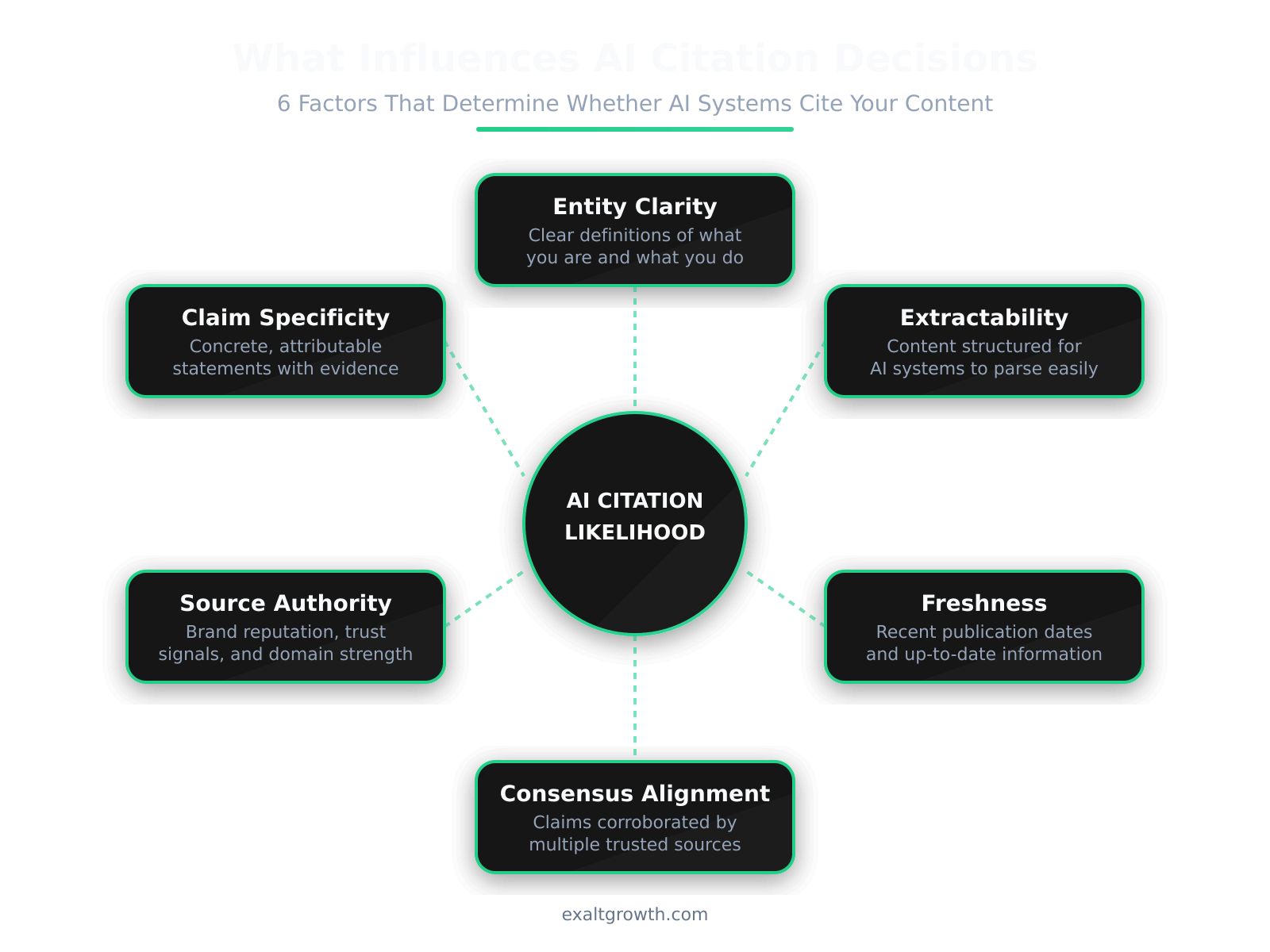
Based on analysis of AI system behaviors and published research, several factors influence whether content gets cited:
1. Entity Clarity
Content that clearly defines what an entity is, what it does, and how it relates to other entities is easier for AI to retrieve and cite accurately.
2. Claim Specificity
Specific, attributable claims ("reduces onboarding time by 40%") are more citable than vague assertions ("improves efficiency").
3. Structural Extractability
Content organized with clear headings, defined lists, and explicit statements is easier for AI to parse and quote.
4. Source Authority
Brand reputation, domain authority, and the presence of corroborating mentions across the web influence credibility assessment.
5. Information Freshness
Recent content with current information often receives preference, particularly for time-sensitive queries.
6. Consensus Alignment
Claims that align with information consensus across multiple sources are more likely to be included than outlier positions.
Generative Engine Optimization Strategy: The Entity-First Framework
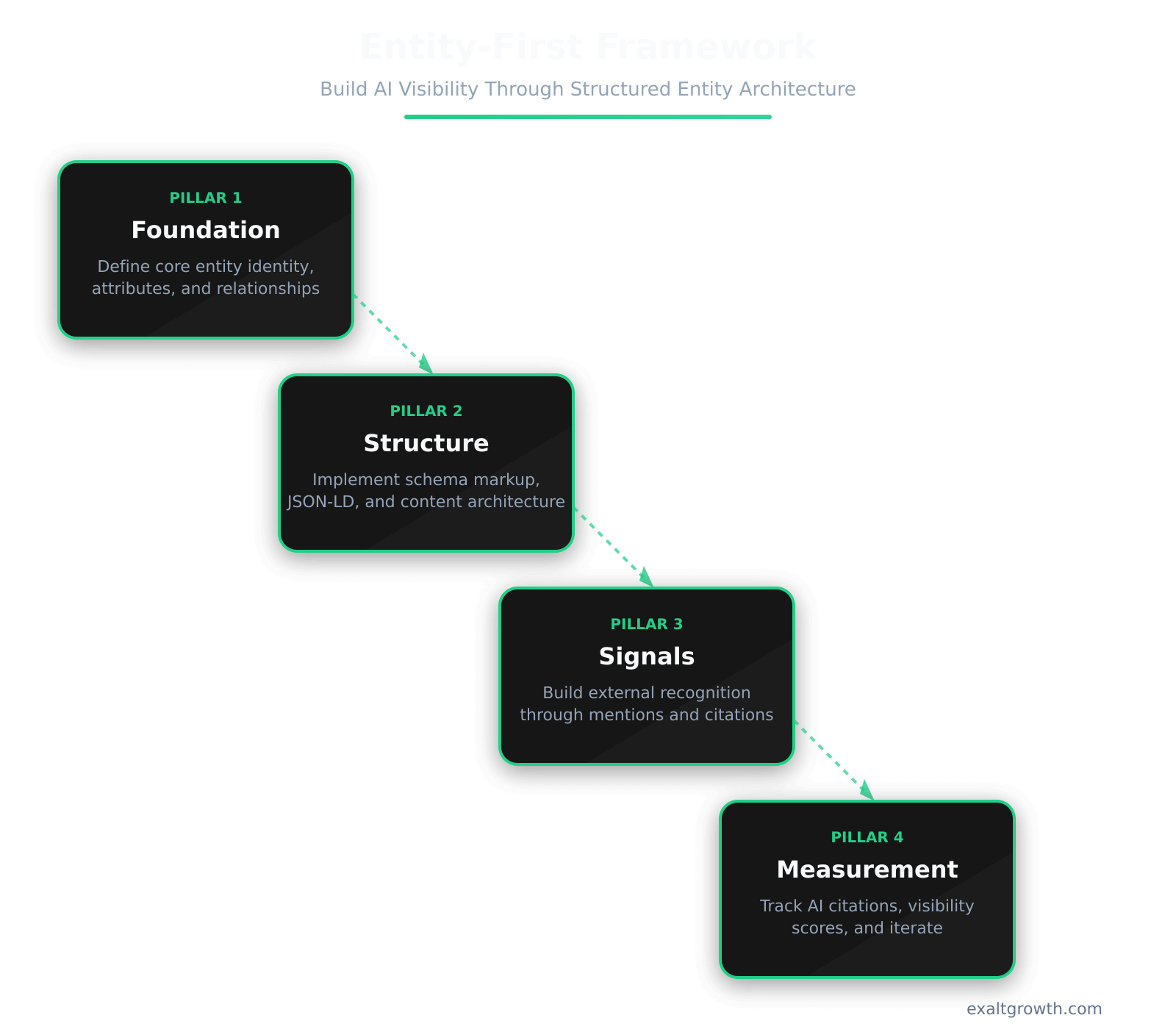
Effective GEO requires a systematic approach. At Exalt Growth, we use an entity-first framework that builds AI visibility from foundational clarity through ongoing optimization.
Foundation: Entity Architecture
Before optimizing content, establish clear entity definitions that AI systems can understand.
Define Your Primary Entity
What is your product or service? Create explicit definitions that disambiguate you from competitors and related concepts. Include:
- Category classification
- Core functionality description
- Target user/customer definition
- Key differentiators
- Relationship to adjacent solutions
Map Entity Relationships
Document how your entity relates to:
- Parent categories (what type of solution you are)
- Child entities (features, products, services you offer)
- Peer entities (competitors, alternatives)
- Adjacent entities (integrations, complementary solutions)
Establish Entity Attributes
Define specific, verifiable attributes:
- Quantifiable capabilities
- Unique features
- Use cases served
- Customer segments
- Pricing models
- Geographic availability
Structure: Content Optimization
With entity foundations established, optimize content for AI retrievability.
Extractable Formatting
Structure content so AI can identify and extract specific claims:
- Use clear headings that signal content topics
- Lead paragraphs with key assertions
- Include explicit definitions for important terms
- Present data in parseable formats
- Provide specific examples with concrete details
Citation-Worthy Content
Create content worth citing:
- Original research and data
- Specific case studies with measurable outcomes
- Clear methodology explanations
- Expert perspectives with attributed quotes
- Comprehensive comparisons with defined criteria
Semantic Clarity
Write so AI understands context:
- Use consistent terminology throughout
- Define acronyms and industry terms
- Provide context for statistics and claims
- Link related concepts explicitly
Signals: Authority Building
Strengthen the signals that make AI systems trust your content.
Brand Mention Cultivation
Increase the frequency and quality of brand mentions across the web:
- Earn coverage in industry publications
- Participate in expert roundups and interviews
- Contribute to industry research and reports
- Engage in partnerships that generate co-mentions
Review and Rating Signals
Build presence on platforms AI systems reference:
- Software review sites (G2, Capterra, TrustRadius)
- Industry-specific directories
- Professional community platforms
Structured Data Implementation
Deploy comprehensive schema markup:
- Organization schema with complete attributes
- Product/Service schema with features and offers
- FAQ schema for common questions
- How-to schema for process content
- Review schema where applicable
Measurement: Visibility Tracking
Establish systems to measure GEO effectiveness.
AI Visibility Monitoring
Track brand presence across AI platforms:
- Regular prompt testing across ChatGPT, Perplexity, Gemini
- Monitoring for brand mentions in AI responses
- Tracking citation frequency and context
- Competitor visibility benchmarking
Traditional SEO Integration
Connect GEO metrics to broader visibility:
- Branded search volume trends
- Direct traffic patterns
- Referral source analysis
- Conversion path tracking
Technical Foundations for Generative Engine Optimization
GEO success requires technical infrastructure that supports AI content understanding and retrieval.
Schema Markup for AI Visibility
Structured data provides explicit signals that help AI systems understand your content.
Site Architecture for Retrievability
Structure your site so AI systems can efficiently access and understand content relationships.
Topic Clustering
Organize content into clear topical hierarchies:
- Pillar pages for primary topics
- Supporting content for subtopics
- Clear internal linking between related pages
- Consistent URL structures that reflect hierarchy
Content Hubs
Create comprehensive resource centers:
- Glossary pages defining industry terms
- Comparison hubs covering alternatives
- Use case libraries with specific examples
- Resource centers with guides and tools
Navigation Clarity
Ensure logical site structure:
- Descriptive navigation labels
- Breadcrumb implementation
- Sitemap optimization
- Clear page categorization
Content Structure Best Practices
Format content for maximum extractability.
Heading Hierarchy
Use headings that signal content structure:
- H1: Page topic (one per page)
- H2: Major sections
- H3: Subsections
- Descriptive, keyword-aware heading text
Paragraph Structure
Optimize paragraph organization:
- Lead with key assertions
- One main idea per paragraph
- Specific claims before supporting detail
- Clear transitions between concepts
List and Table Formatting
Present structured information clearly:
- Use lists for enumerable items
- Use tables for comparisons
- Include context for data points
- Provide sources for statistics
Measuring Generative Engine Optimization Success
Traditional SEO metrics don't fully capture GEO performance. Effective measurement requires new approaches.
AI Visibility Metrics
Citation Frequency
Track how often your brand appears in AI responses:
- Number of mentions across platforms
- Context of mentions (recommendation vs. reference)
- Competitor mention comparison
- Trend over time
Query Coverage
Measure visibility across relevant query sets:
- Category queries ("best [solution type]")
- Problem queries ("how to solve [problem]")
- Comparison queries ("[your brand] vs [competitor]")
- Feature queries ("[specific capability] software")
Citation Quality
Assess the nature of AI mentions:
- Recommendation strength (mentioned vs. recommended)
- Accuracy of information cited
- Completeness of brand representation
- Sentiment of surrounding context
Proxy Metrics
Until AI platforms provide direct analytics, proxy metrics indicate GEO impact.
Branded Search Volume
Increases in branded searches may indicate AI exposure:
- Monitor branded query trends
- Track branded + category queries
- Compare against competitor branded volume
Direct Traffic Patterns
AI citations often drive direct visits:
- Track direct traffic trends
- Analyze direct traffic by landing page
- Monitor time-on-site for direct visitors
Conversion Path Analysis
Look for AI influence in conversion journeys:
- Survey new customers on discovery path
- Track first-touch attribution patterns
- Monitor "dark funnel" indicators
GEO Dashboards and Tools
Several platforms support GEO measurement:
Hall — Tracks brand visibility across AI platforms with citation monitoring
Profound — Monitors AI search appearances and provides competitive benchmarking
seoClarity — Includes AI visibility tracking within broader SEO suite
Manual Prompt Testing — Regular testing of relevant prompts across ChatGPT, Perplexity, and Gemini
Setting GEO Benchmarks
Establish baselines before optimization:
- Test 50 to 100 relevant prompts across platforms
- Document current citation frequency and context
- Identify competitor visibility for same prompts
- Set improvement targets by query category
- Establish testing cadence (weekly or monthly)
Common Generative Engine Optimization Mistakes
Avoid these pitfalls when implementing GEO strategies.
Mistake 1: Optimizing for Keywords Instead of Entities
Traditional keyword optimization doesn't translate directly to GEO. Targeting keyword variations without establishing clear entity definitions confuses AI systems.
Better approach: Start with entity architecture. Define what you are clearly before optimizing for how people search for it.
Mistake 2: Ignoring Consensus Signals
Making claims that contradict established information consensus without strong evidence reduces citation likelihood. AI systems favor information that aligns with multiple sources.
Better approach: When making differentiated claims, provide clear evidence and context. Acknowledge the standard view before presenting your perspective.
Mistake 3: Creating Content Without Extractable Structure
Long-form content that buries key claims in dense paragraphs is difficult for AI to cite. If an AI can't quickly identify what to extract, it will cite something else.
Better approach: Structure content with clear assertions, specific data points, and explicit definitions that AI can easily identify and attribute.
Mistake 4: Neglecting Offsite Signals
Focusing only on owned content ignores the importance of brand mentions, reviews, and third-party validation that AI systems use to assess authority.
Better approach: Build comprehensive visibility through earned media, review platforms, industry directories, and expert contributions.
Generative Engine Optimization for SaaS Companies
SaaS companies face unique GEO challenges and opportunities.
Why SaaS Companies Need GEO
Complex buyer journeys benefit from AI assistance
B2B SaaS purchases involve multiple stakeholders, extended research phases, and detailed requirements. AI tools help buyers navigate this complexity, making AI visibility critical.
Category competition is intense
Most SaaS categories have numerous competitors. AI systems must differentiate between options, making clear entity definition essential.
Product capabilities are detailed
SaaS products have specific features, integrations, and use cases that AI can cite when properly structured.
Buyer expectations are evolving
Technical buyers increasingly start research with AI queries rather than Google searches.
SaaS GEO Priorities
Feature and Use Case Clarity
Document specific capabilities in extractable formats:
- Clear feature definitions with concrete functionality descriptions
- Use case pages with specific problem-solution framing
- Integration documentation with partner context
- Pricing information with plan comparisons
Comparison Content
Create resources AI can reference for evaluation:
- Direct competitor comparisons with specific criteria
- Category alternative pages
- Migration and switching guides
- Feature-by-feature breakdowns
Social Proof Structure
Format validation signals for AI extraction:
- Case studies with quantified outcomes
- Customer testimonials with specific context
- Review aggregation with platform references
- Award and recognition documentation

FAQs About Generative Engine Optimization
What is Generative Engine Optimization?
Generative Engine Optimization (GEO) is the practice of optimizing content and digital presence for visibility within AI-powered search systems like ChatGPT, Google AI Mode, and Perplexity. Unlike traditional SEO which focuses on ranking in search results, GEO focuses on getting cited and recommended in AI-generated answers.
How is GEO different from SEO?
SEO optimizes for search engine rankings and click-through rates. GEO optimizes for AI citation and inclusion in generated answers. While both disciplines share foundations in quality content and technical optimization, GEO requires additional focus on entity clarity, content extractability, and citation-worthiness.
What are the early benchmarks for generative engine optimization in the saas industry?
GEO benchmarks are still emerging as the industry matures, but early metrics focus on brand citation frequency across AI platforms like ChatGPT, Perplexity, and Gemini. Leading SaaS companies track citation rate (how often you appear in relevant AI responses), share of voice compared to competitors, and inclusion consistency across different AI engines.
Most teams build query test sets of 100 to 250 prompts relevant to their category and monitor performance monthly. Early data suggests top performing SaaS brands achieve 15 to 30% citation rates for high intent category queries.
At Exalt Growth, we help SaaS companies establish GEO baselines and build measurement infrastructure to track AI visibility alongside traditional SEO metrics.
Does GEO replace SEO?
No GEO extends SEO rather than replacing it. Effective digital visibility requires optimization for both traditional search and AI systems. The most successful strategies integrate both disciplines within unified content and technical approaches.
How do I measure GEO success?
GEO measurement combines AI visibility tracking (citation frequency, query coverage, mention context) with proxy metrics (branded search volume, direct traffic trends, conversion path analysis). Several platforms now offer AI visibility monitoring, and manual prompt testing provides additional insight.
How long does GEO take to show results?
GEO typically requires 3 to 6 months to show measurable citation improvements. AI system updates and retraining cycles affect how quickly optimizations take effect. Leading indicators like branded search volume may show movement earlier.
What's the relationship between GEO and entity SEO?
Entity SEO focuses on helping search engines understand what entities (people, places, things, concepts) your content discusses. GEO builds on entity SEO principles, applying them specifically to AI system optimization. Strong entity architecture is foundational to effective GEO.
Which AI platforms should I optimize for?
Priority platforms include Google AI Mode and AI Overviews (highest search volume), ChatGPT (growing usage for research), and Perplexity (popular for detailed queries). Optimization efforts generally benefit visibility across multiple platforms since underlying principles are similar.
Can I do GEO myself or do I need an agency?
Basic GEO implementation is achievable in-house, particularly for teams with existing SEO expertise. Complex implementations, competitive categories, and companies seeking accelerated results often benefit from specialized agency support.