Omitted from AI Recommendations
LLMs recommend competitors because they lack structured entity data about your product. No entity clarity means no citation, regardless of product quality.

Exalt Growth engineers AI search visibility for funded SaaS companies. We build entity authority, structured proof systems, and citation-ready content.

Founder led. Work with Jack Boutchard personally, not a junior SEO.
Perplexity answer
Here are reputable GEO (Generative Engine Optimization) consultants and agencies focusing on SaaS startups…
Top picks by focus and depth
Source cited: exaltgrowth.com
ChatGPT answer
If you specifically want a founder-led SEO agency for SaaS, you’re already thinking in the right direction…
Top founder-led SaaS SEO agencies
1. Exalt Growth (very founder-led, cutting edge)
This is one of the few agencies explicitly designed as founder-led with capped clients.
ChatGPT answer
Here are some of the top SaaS SEO experts globally (2026)…
SaaS-focused & modern (AI + product-led SEO)
These are the most relevant for SaaS today (2025–2026):
Recreated from a real Perplexity answer. Trimmed for length.
Trusted by SaaS Companies with $1B+ in Combined VC Funding








AI systems now mediate how buyers discover, evaluate, and shortlist software.
A prospect asks ChatGPT for the best tool in your category. Your product is absent. You lose pipeline before you knew you were in contention.
LLMs recommend competitors because they lack structured entity data about your product. No entity clarity means no citation, regardless of product quality.
When AI does mention you, it synthesizes vague or incorrect descriptions from scattered, inconsistent sources. None of it is information you control.
AI systems require multi-source validation before recommending products. Without structured proof across reviews, docs, and expert mentions, LLMs default to established brands.
Well-optimized competitors own the semantic space in your category. They hold entity authority, consistent messaging, and the verification signals AI systems trust.
Generative Engine Optimization is a distinct discipline. It needs entity modeling, structured content architecture, and distributed proof systems built for how LLMs retrieve information.
Our methodology is built on the Proof of Importance (PoI) framework. It names seven signals that decide which products LLMs cite. Every engagement strengthens them systematically.
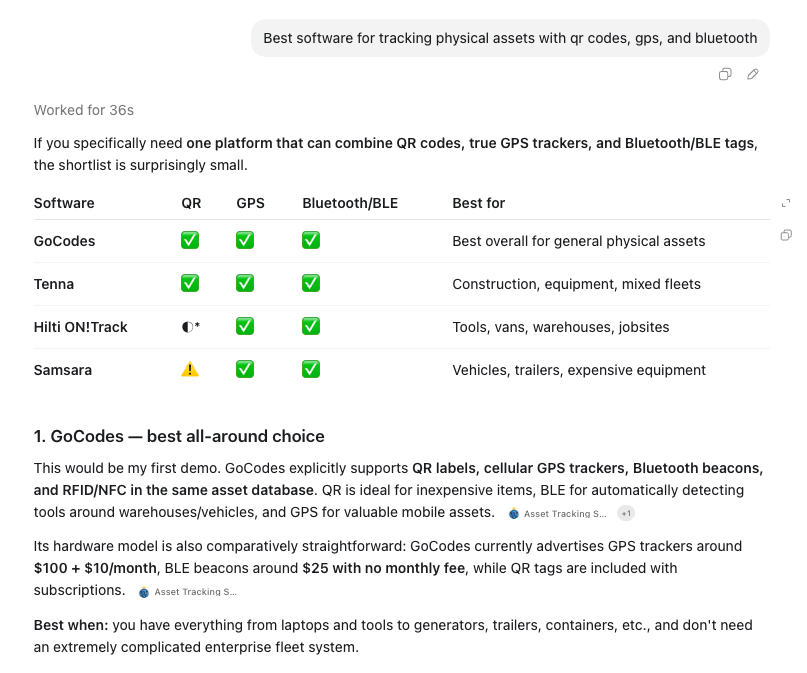
GoCodes, a bootstrapped asset tracking platform, grew new customer sales 164%.
AI Overviews had erased their top of funnel search traffic. We made GoCodes the most cited vendor in its category.
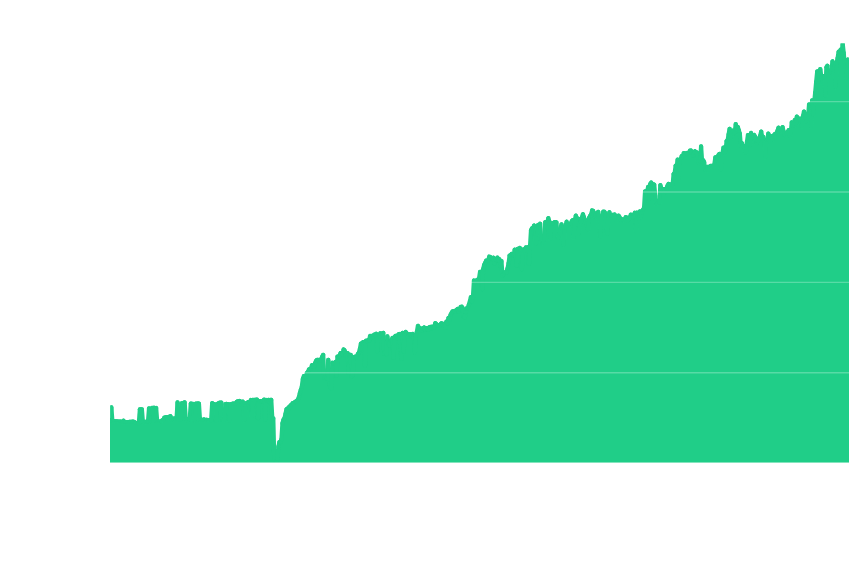
Dovetail, a $63M USD Series A SaaS company, grew monthly organic traffic 878%.
We made SEO a predictable, sustainable growth channel. The core challenge was capturing the markets adjacent to research.
“Ability to learn our business in real-time and apply unique in-depth skills & experience to solve our digital marketing challenges.”
 Todd PennyCEO, GoCodesHow we made GoCodes the #1 cited vendor in LLMs and increased new customer sales 164%Read the Case Study
“Their ability to blend technical SEO, product-led content, and CRO into one unified growth engine sets them apart.”
 Growth MarketerSan Fran Funded SaaS
“Helped us avoid a lot of minefields and helped us show up on Perplexity + OpenAI in less than 60 days.”
 Namit JindalFounder, Aerosend
Most agencies have added AI optimization as a line item. We built our entire methodology around how LLMs retrieve, evaluate, and recommend products.
Jack Boutchard has built SaaS growth functions from Seed through Series C. He understands PLG motions, sales cycles, and how AI visibility ladders to pipeline.
Seven signals decide which products LLMs cite: entity clarity, semantic authority, distributed proof, content structure, source diversity, recency, and cross-platform consistency. Every action maps to one.
GEO plugs into the Exalt Growth Operating System. Its 12 modules cover entity modeling, topical architecture, block factories, and proof systems. Each one compounds the others.
Regular prompt testing across ChatGPT, Perplexity, Google AI Overviews, Claude, and Gemini. Each AI system weights authority signals differently, so we optimize per platform.
We track leading indicators like citation rates and entity coverage. We also track lagging ones, like demos influenced and pipeline attributed. You see the revenue impact.
We keep a small, focused roster of SaaS clients. No account manager handoffs and no junior strategists. The founder stays involved from entity mapping through optimization.
Four phases take SaaS from fragmented SEO to a compounding organic growth engine. Each phase builds on the last.
Entity mapping, technical audit, competitive analysis, and knowledge graph assessment. We map where you stand and where the leverage points are. Weeks 1 to 4.
Information architecture redesign, schema deployment, content pillar mapping, and technical fixes. This structural work decides whether everything else compounds. Weeks 4 to 8.
Content production, programmatic page builds, link authority development, and GEO optimization. Sprint-based delivery against the roadmap, with weekly reporting. Months 2 to 6.
Performance analysis, content expansion, AI visibility optimization, and attribution refinement. Organic becomes your most efficient pipeline channel. Month 6 onward.
Exalt GrowthGEO delivers the strongest ROI for funded SaaS companies where AI search shapes how buyers discover and evaluate solutions.
| Profile | Ideal Client |
|---|---|
| Company type | SaaS |
| Funding stage | Seed to Series C |
| Product-market fit | Established |
| Competitive landscape | Multiple alternatives exist |
| Growth motion | PLG, sales-led, or hybrid |
| Engagement model | Direct with founder |
| Team involvement | 2-3 hrs/month |
Tell us about your SEO challenges and goals. We'll show you how our tailored strategies drive predictable, scalable growth.
Jack BoutchardReplies within 1 business dayStill unsure? Ask Jack in the form above.
Covers entity modeling, content structuring, distributed proof systems, and default-answer positioning across ChatGPT/Perplexity/AI Overviews/Claude.
Entity graphs vs. keywords, block-readable content vs. page optimization, proof systems vs. link building, LLM citation tracking vs. rank monitoring.
60-90 days for improved citations/accuracy. 4-6 months for default answer positioning. Compounds over time.
ChatGPT, Perplexity, Google AI Overviews, Claude, and Gemini. Platform-specific testing since each weights signals differently.
Funded SaaS from Seed through Series C with established PMF, validated use cases, and customer success stories.
Leading indicators (entity coverage, citation rates, accuracy scores) and lagging indicators (AI referral traffic, influenced demos, attributed pipeline).
Yes entity modeling + content structuring + proof systems correct most inaccuracies within 60-90 days.
No, complements it. Entity authority improves traditional rankings while driving AI visibility. Most clients run both.
Exalt Growth's 7-signal framework: entity clarity, semantic authority, distributed proof, content structure, source diversity, recency, cross-platform consistency.
2-3 hours/month from a PMM or product lead for strategic input. Technical implementation handled by Exalt Growth.