How to be Recommended on ChatGPT: Guide for SaaS
AI-driven search models like ChatGPT are reshaping the way users discover content online, as the platform has hit over 900 million weekly active users as of March 2026.
This as expected leads to the question of how to rank a website on ChatGPT? Asking Reddit “how to rank for ChatGPT” results in comedic answers like “be sure to use please and thank you in your robots.txt file.” But there is a method behind making websites more visible to LLMs.
If you want your website to be referenced in ChatGPT’s responses, follow our structured approach to optimizing your content.
Related readings:How ChatGPT Works: From Query to Citation
ChatGPT is not a search engine. It is an intelligent orchestrator that decomposes, multiplies, and merges searches across multiple sources before synthesizing a single answer.
Understanding this architecture is the foundation for SaaS visibility in AI search.
The Sonic Classifier: ChatGPT's Search Gate
Before ChatGPT ever retrieves external content, a probabilistic classifier called Sonic determines whether your query needs fresh web data at all. Sonic assigns a probability score to every prompt. If that score falls below the activation threshold (observed at approximately 65%), ChatGPT answers entirely from its parametric memory. No search is triggered. No external content is retrieved.
This means ChatGPT answers many queries without ever looking at the web.
For SaaS companies, this creates a two-layer optimization challenge. Your brand needs to exist in ChatGPT's training data (parametric memory) and in retrievable web content. A strong web presence alone is insufficient if Sonic decides the query can be answered from memory. Conversely, strong brand recall in training data is insufficient for queries where Sonic triggers fresh retrieval.
Sonic classification happens in under 200 milliseconds. The decision is final for that response cycle. There is no fallback.
Two Layers of Visibility
The Sonic Classifier reveals a fundamental split in how ChatGPT surfaces brands. There are two distinct visibility layers, and each requires a different optimization strategy.
Parametric visibility
This is what the model already knows from its training data. When Sonic scores a query below the search threshold, ChatGPT answers entirely from this layer. No web retrieval is triggered. No external content is evaluated. Your brand either exists in the model's weights or it does not.
Dynamic visibility
This is what the model retrieves in real time when Sonic triggers a search. This layer depends on fan-out queries, Google rankings, and the recency filters applied to results. It is closer to traditional SEO and can shift overnight with a model update.
The two layers are not independent. Parametric knowledge directly shapes dynamic behavior in two ways.
Upstream: fan-out formulation
The model generates its search queries by targeting sources it already recognizes from training. A brand absent from parametric memory will not be considered as a search candidate. It will not appear in the fan-out queries ChatGPT generates.
Downstream: source selection
Among retrieved results, the model favors sources embedded in its weights. Known brands receive more frequent citations, higher positioning, and more favorable framing in the final response.
Being unknown to the model means being invisible before search even starts. Parametric awareness is the prerequisite for dynamic visibility.
For SaaS companies, this creates two distinct workstreams with different timelines:
| Layer | Actions | Timeline |
|---|---|---|
| Parametric (search off) | Wikipedia/Wikidata entries, PR coverage, presence in training corpora (Common Crawl, authoritative publications), brand mentions on reference sites | Medium to long term. Stable between knowledge cutoff updates. |
| Dynamic (search on) | Google rankings, content freshness, structured data, meta descriptions, review platform presence | Short term. Volatile. Changes with every model update. |
Measuring only one layer produces a misleading picture. A brand can have strong dynamic visibility (ranking well for fan-out queries) but weak parametric visibility (unknown to the model when search is off). The reverse is equally possible. Track both independently. Then use those results to improve LLM visibility across both layers.
Fan-Out: One Query Becomes Many
When Sonic triggers a search, ChatGPT does not send a single query to a single search engine. It activates multiple parallel fan-out mechanisms, each targeting a different type of index.
Search fan-outs
Generate 1 to 3 web queries in standard mode, scaling to 20+ in thinking mode. These are reformulated versions of the user's original prompt, optimized for different angles of the same question.
Shopping fan-outs
Generate shorter, product-centric queries mapped directly to e-commerce results. These follow distinct generation rules from search fan-outs.
Image fan-outs
Generate 3 to 8+ visual queries for illustrations and event coverage. Since January 2026, image fan-outs can scale to 25+ queries per conversation.
These layers fire simultaneously but are rarely combined all three together. Most conversations trigger two types: Search + Shopping or Search + Images.
For a query like "best project management tools for startups," ChatGPT might generate parallel search fan-outs including "project management software comparison 2026," "PM tools for early stage startups," and "lightweight project management apps." Each fan-out returns its own result set. All results are then merged using Reciprocal Rank Fusion (RRF) before the model synthesizes its answer.
The optimization implication is direct. Your content does not need to rank for the exact user query. It needs to rank for the reformulated fan-out queries ChatGPT generates from that prompt.
Retrieval, Selection, Citation: Three Separate Jobs
Winning visibility in ChatGPT requires passing three distinct gates:
- Be retrieved. Your content must appear in results for at least one fan-out query. This is an SEO foundation problem.
- Be selected. The LLM evaluates all retrieved content and ranks what it will use. Entity coherence, evidence density, and structural clarity determine selection.
- Be cited. Appearing in the final answer with a visible citation link. Not all selected content earns a citation.
Stop thinking in pages. Start thinking in answer chunks: discrete, defensible, correct, easy to cite. See which content gets cited in AI search for B2B SaaS.
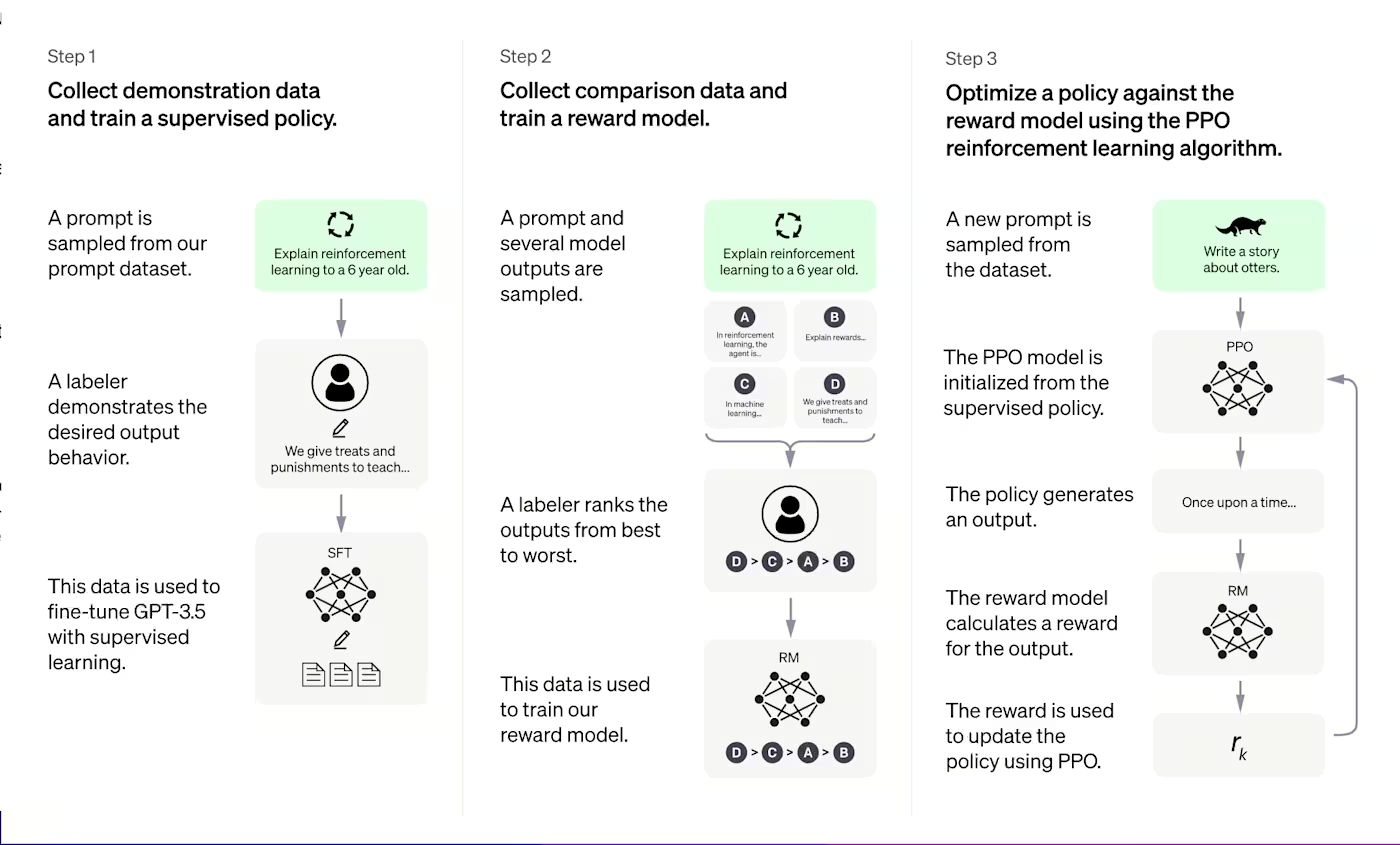
How ChatGPT Works
How ChatGPT Retrieves Web Content
Understanding ChatGPT's data supply chain reveals why certain optimization strategies work and others fail entirely.
The Provider Ecosystem
ChatGPT's web search results come primarily from Google, not Bing. Reverse engineering of ChatGPT's source code reveals that OpenAI uses SerpAPI as its primary web search provider. SerpAPI scrapes Google's search results and returns them to ChatGPT for processing.
This was confirmed through multiple vectors: SerpAPI source references found directly in ChatGPT's codebase, Base64 token structures matching SerpAPI's API format, and OpenAI's previous listing as a client on SerpAPI's website (later removed). Nick Turley, Head of Product for ChatGPT, acknowledged under oath during the US v. Google antitrust trial that OpenAI was "still years away" from answering 80% of queries from its own index.
For SaaS companies, the practical takeaway is clear. Ranking in Google is not just a traditional SEO objective. It is the primary retrieval mechanism for ChatGPT Search. If your content does not rank well in Google for the fan-out queries ChatGPT generates, it will not be retrieved for AI answers either.
The Recency Mechanism
The SEO community has observed that ChatGPT citations heavily favor recent content. The infrastructure explains why.
ChatGPT's training data already contains older web content up to its knowledge cutoff date. When it searches the web, it is not rebuilding its knowledge base. It is filling the gap between its cutoff and the present moment. The system applies explicit date filters to fan-out queries: 1 day, 7 days, 14 days, or 30 days depending on query context.
A breaking news query triggers a 1 day filter. A "best tools" query might use a 30 day or 365 day window. But crucially, these filters are applied before results reach the model. Older content is excluded at the retrieval layer. It never has the opportunity to be selected or cited.
For SaaS companies publishing evergreen content, this means regular updates are not a nice-to-have. They are a structural requirement. Update your dateModified schema property. Refresh statistics. Add current data points. Content that has not been updated within the relevant recency window is invisible to ChatGPT's search mode, regardless of its quality.
Three Types of Citations
Not all ChatGPT references carry equal visibility. The system produces three distinct citation tiers:
| Citation Type | User Visibility | SEO Impact |
|---|---|---|
| Inline Citations | Numbered links [1][2][3] displayed directly in the response text. Maximum visibility. | High. Drives click-through traffic. |
| "More" Sources | Links in the expandable Sources panel below the response. Requires a click to view. | Moderate. Visible but secondary. |
| Hidden Links | URLs consumed for grounding but never displayed to the user. | Minimal. Influences the answer but generates zero traffic. |
This distinction matters for measurement. Studies claiming that Arxiv or YouTube are among ChatGPT's "most cited domains" likely conflated hidden grounding links with visible citations. Arxiv dominates the hidden link category. Users never see those references.
When tracking your SaaS brand's ChatGPT visibility, distinguish between inline citations (maximum value), "More" sources (moderate value), and hidden links (influence only). Measuring them as a single category overstates or understates your actual visibility depending on the mix.
Domain Concentration: Fewer Sites, Higher Stakes
In March 2026, OpenAI switched ChatGPT's default model from GPT-5.2 to GPT-5.3 Instant. The impact on web visibility was immediate.
A study tracking 27,000 responses across 400 prompts over 14 weeks found that the average number of unique domains cited per response dropped 20.5%, from 19.1 to 15.2. URLs per response fell 21%. The ratio of URLs per domain stayed flat at 1.26. Crawl depth did not change. What changed is the number of distinct websites that share each response's citation surface.
Fewer domains now occupy more space per response. The dynamic mirrors what Moz's Dr. Pete called the "Bigfoot update" when Google began letting single domains dominate page one results in 2013. ChatGPT is producing the same concentration pattern.
GPT-5.4 amplifies this further. The model now uses site: operators in its fan-out queries, directing searches toward specific trusted domains. Review platforms like G2, Clutch, and Capterra are among the domains targeted by name. The model is not just retrieving from these sources when they happen to rank. It is actively querying them as designated authority sites.
For SaaS companies, the strategic implication is direct. Third-party review presence is no longer just a credibility signal. It is a retrieval mechanism. If your product is not listed with complete, current information on the platforms ChatGPT queries by name, you are excluded from an expanding share of responses.
With 90%+ of ChatGPT's weekly users on the free tier, the default experience (GPT-5.3 Instant) triggers fewer web searches, uses fewer queries, and produces fewer citations than paid models. Each citation slot carries more weight than it did six months ago.
How ChatGPT Classifies Entities
Beyond basic natural language processing, ChatGPT operates with a hidden entity layer that categorizes and structures information about people, organizations, products, and events. Understanding this internal classification system is essential for optimizing your SaaS website's visibility.
Recent analysis of ChatGPT's Server Sent Event (SSE) streams reveals that the system doesn't just process text. It builds structured entity references that persist across conversation turns and influence which sources get cited.
ChatGPT's Entity Classification System
ChatGPT's internal architecture recognizes entities through a proprietary NER (Named Entity Recognition) system that has expanded significantly since early 2026. The system now supports 35+ entity types, up from approximately 20 in late 2025.
The five categories most relevant to SaaS companies:
| Entity Type | What It Represents | SaaS Relevance |
|---|---|---|
| Company | Businesses, institutions, brands | Your SaaS company, competitors, integration partners |
| Software | Software products, applications, tools | Your SaaS product and its category classification |
| Brand | Commercial brands distinct from their parent organization | Product brand identity separate from company entity |
| Person | Founders, executives, thought leaders | Author credibility, expertise signals |
| Organization | Broader institutional entities (NGOs, governments, industry bodies) | Industry associations, standards bodies relevant to your space |
Beyond these, ChatGPT classifies entities across categories including mobile_app, product, event, academic_field, scientific_concept, disease, stock, cryptocurrency, artwork, food, animal, and dozens more.
The most significant architectural change: the taxonomy is now open-ended. ChatGPT can generate entity types dynamically using a <generated_entity_type> mechanism when no predefined category fits. This means the system is no longer limited to a fixed classification set. If your SaaS product operates in a niche category, the model can create a classification for it on the fly.
Each entity reference now includes a disambiguation string. When ChatGPT mentions your brand, it attaches a descriptor that determines how the entity is classified and retrieved. For example: ["company", "Notion", "productivity and collaboration platform"] or ["software", "Figma", "design tool"]. This disambiguation shapes which queries your brand surfaces for and how it is positioned relative to competitors.
Why This Matters for SaaS Visibility
1. Entity recognition drives citation selection
Content that clearly establishes entity relationships (your company builds a specific product that solves a defined problem) is more likely to be understood and referenced. Marketing language that obscures these relationships weakens entity coherence.
2. Cross-source validation strengthens entity position
ChatGPT validates entities by checking for consistent mentions across multiple sources. If your SaaS appears as a software entity across G2, Capterra, industry publications, and your own structured data, you reinforce your position in the entity graph.
3. Disambiguation determines competitive framing
The disambiguation string attached to your entity affects which competitors you are grouped with. If ChatGPT disambiguates your product as "project management software" rather than "work management platform," it will surface alongside a different competitive set. Your structured data, product descriptions, and third-party listings all feed this classification.
Schema.org to ChatGPT Entity Mapping
To align your structured data with ChatGPT's expanded entity layer, map your schema types to the classifications the system uses internally:
| ChatGPT Entity | Schema.org Type | Essential Properties | SaaS Implementation |
|---|---|---|---|
| Company | Organization | name, url, logo, sameAs, brand, foundingDate, founder | Company pages, about pages, footer schema |
| Person | Person | name, jobTitle, worksFor, sameAs, image, knowsAbout | Team pages, author bylines, founder profiles |
| Software | SoftwareApplication + Offer | name, description, applicationCategory, operatingSystem, offers.price, aggregateRating | Product pages, pricing pages, feature pages |
| Brand | Brand | name, logo, url, slogan | Brand-level schema distinct from Organization |
| Event | Event | name, startDate, location, organizer, description | Webinar pages, launch announcements |
The sameAs Property: Your Entity Validation Signal
The sameAs property functions as your entity verification mechanism by linking your primary entity to established external profiles. When ChatGPT encounters consistent entity information across your schema markup and the destinations in your sameAs links, it strengthens your position in the entity graph.
sameAs destinations include:
- LinkedIn company page
- Crunchbase profile
- G2 or Capterra listing
- Wikidata entry
- Wikipedia page (if applicable)
- Official social media profiles
- Industry directory listings
Each destination should contain consistent entity descriptions that reinforce your core positioning and disambiguation.
Free vs Paid Tier Differences
Research indicates that ChatGPT's entity infrastructure differs between free and paid tiers. The richer entity layer with full metadata is primarily active in paid versions, while free users interact with a more limited system. This suggests that your target audience (likely using paid ChatGPT for business research) will encounter the full entity classification system when evaluating SaaS solutions.
6 ChatGPT Ranking Factors
Now that we’ve established how ChatGPT selects content differently from Google, it’s time to break down the six most influential factors that determine whether your website gets referenced in AI-generated responses. Key factors that influence ChatGPT’s content selection:
1. Relevance to the User Query
ChatGPT aims to provide direct, concise, and helpful answers based on searcher intent. Websites that address common user queries in an easy-to-digest format are more likely to appear in responses.
Semantic Match with Search Intent – ChatGPT looks for content that directly addresses the user’s question, rather than just containing related keywords.
Depth of Coverage – Comprehensive content that explores a topic holistically (covering FAQs, subtopics, and related questions) is more likely to be referenced.
Conversational & Contextual Fit – AI prefers content that is written in a natural, easy-to-understand, and conversational manner, similar to how ChatGPT responds to users.
2. Authority & Credibility - Brand Mentions
ChatGPT prioritizes content from established sources that demonstrate expertise in their field. Websites that are frequently mentioned, cited, or linked to from reputable sources are more likely to be used. Credibility also ranks among the top factors driving LLM visibility.
Reputable Sources Preferred – ChatGPT prioritizes content from authoritative sources such as news organizations, government websites, and academic institutions.
Backlinks & Mentions Matter – While ChatGPT doesn’t rank based on backlinks directly, content that is widely cited in trusted sources is more likely to be referenced.
Expert Authorship – AI prefers information from recognized experts, thought leaders, and organizations with established authority in their industry.
3. Citations & External Mentions
ChatGPT references sources that are frequently mentioned, cited, or linked by other authoritative sources.
Appearing in Other AI-Referenced Content – If multiple trusted sources reference your website, ChatGPT is more likely to use your content.
Industry Recognition & PR Mentions – Being featured on platforms like Wikipedia, industry publications, or reputable blogs boosts visibility.
Consistent Presence Across Platforms – AI models tend to trust content that appears across multiple credible sources, rather than isolated websites.
4. Accuracy & Trustworthiness
AI models prefer factually correct, well-researched content. If a website contains outdated, misleading, or unverified information, it is unlikely to be referenced in responses.
ChatGPT favors results with the inclusion of statistics, citations, and quotations from relevant sources. One study conducted over 10,000 queries found that source visibility increased over 40% when including relevant data.
Factually Correct Information – ChatGPT is designed to avoid misinformation, meaning well-researched, fact-checked content has a better chance of being used.
Updated Content – Since ChatGPT’s knowledge is periodically updated, content that remains current and aligns with newer sources is more likely to be referenced.
Transparency & Sources Cited – Content with clear sourcing, external references, and citations increases its credibility and usage in AI-generated responses.
5. Structural Accessibility and Machine Readability
ChatGPT and most major LLM crawlers do not execute JavaScript. Testing across eight LLM crawlers shows that ChatGPT, Claude, and Gemini all fail to process JS-rendered content. Only Bing Copilot can read iframes and Shadow DOM. Grok executes JS but with a 1 to 2 second delay.
If your SaaS product pages render critical content via JavaScript (pricing tables, feature comparisons, customer testimonials), that content is invisible to most AI crawlers. Use server-side rendering or <noscript> fallbacks for any content you want LLMs to retrieve.
| Crawler | JS Execution | Shadow DOM | iframes |
|---|---|---|---|
| ChatGPT | ✗ No | ✗ No | ✗ No |
| Claude | ✗ No | ✗ No | ✗ No |
| Gemini | ✗ No | ✗ No | ✗ No |
| Bing Copilot | ✓ Yes (~53ms) | ✓ Open only | ✓ Yes |
| Grok | ✓ Yes (1-2s) | ✗ No | ✗ No |
Beyond rendering, structure determines extraction efficiency. Well-organized content earns a 2.3x citation advantage over unstructured prose. AI models favor:
Clear heading hierarchies
(H1, H2, H3, H4) that chunk content into retrievable sections. Each heading should function as a standalone topic label.
Schema markup
That provides machine-readable context. While most AI crawlers do not yet process JSON-LD directly during crawl, this is expected to be the first structured data format they adopt. Prepare now with clean, comprehensive JSON-LD including sameAs, mainEntityOfPage, FAQPage, and dateModified properties.
Meta descriptions that front-load critical information
When ChatGPT scrapes Google results via its fan-out system, it receives the page title, snippet, and URL. The snippet is your meta description approximately one-third of the time. Google rewrites it the other two-thirds. Front-load the most important claim or fact into the first 100 characters of your meta description. This text may be the only representation of your page that ChatGPT evaluates before deciding whether to retrieve the full content.
URL slugs with relevant keywords
The full URL is transmitted alongside Google SERP results. Keywords in your URL path provide additional context signals to the LLM during the selection phase.
FAQ sections and definition blocks
T hat create self-contained, extractable answer chunks. Each question-answer pair should be independently citable without requiring surrounding context.
6. Alignment with AI & NLP Optimization
Since ChatGPT is built on natural language processing (NLP), content that is optimized for AI comprehension has a higher chance of ranking.
Understands User Intent: ChatGPT uses NLP to interpret the meaning behind queries, ensuring content that aligns with intent is prioritized.
Entity Recognition: AI identifies key entities (people, places, concepts) in content, making well-structured, informative pages more likely to be referenced.
Semantic Analysis: Instead of relying solely on keywords, NLP helps ChatGPT evaluate the contextual relationships between words and phrases.
Context Awareness: ChatGPT considers sentence structure and logical flow, favoring content that is well-organized and easy to interpret.
Conversational Understanding: NLP enables AI to recognize natural language patterns, increasing the likelihood of ranking content that is written in a user-friendly, engaging style.
Now that we’ve broken down ChatGPT’s ranking factors, the next step is optimizing your content to align with AI-driven selection principles. Let’s explore the exact strategies you can use to improve your visibility in ChatGPT-generated responses.

How to Rank on ChatGPT: 4 Strategies for SaaS
To increase the likelihood of your content being referenced in ChatGPT-generated responses, it’s crucial to align with AI-driven content selection principles focusing on authority, accuracy, relevance, and structured formatting.
Below are the proven generative engine optimization strategies for optimizing your SaaS website for visibility in ChatGPT’s responses.
1. Build Entity Coherence Across the Retrieval Stack
ChatGPT maintains an internal entity classification system that categorizes brands, products, people, and events. Recent analysis shows that the entity layer has evolved from static identifiers to dynamic disambiguation strings. When ChatGPT encounters your brand name, it now attaches a disambiguation descriptor (e.g., "project management SaaS" or "AI sales platform") that determines how your entity is classified and retrieved.
Strengthening your entity coherence requires consistency across three layers:
Parametric memory (training data)
Your brand needs consistent mentions across authoritative sources that ChatGPT has ingested during training. Wikipedia and Wikidata are the highest-impact sources. Wikipedia is ChatGPT's most frequently cited source. Wikidata feeds entity disambiguation directly. If your SaaS company does not have entries on both, you may not exist in ChatGPT's entity graph.
Retrieval layer (Google results)
Since ChatGPT retrieves web results now primarily through Google via SerpAPI, your Google SERP presence directly determines whether you surface in ChatGPT responses. Traditional SEO performance is not separate from AI visibility. It is the foundation.
Corroboration layer (cross-source validation)
ChatGPT validates entities by checking for consistent mentions across multiple sources. Deploy sameAs schema properties linking to your LinkedIn, Crunchbase, G2, Capterra profiles, and any industry directory listings. Each destination should contain consistent entity descriptions reinforcing your core positioning.
Do not separate link building from mention building. A backlink feeds Google. A brand mention feeds LLMs. Every piece of partner or PR content should achieve both. When securing coverage, ensure the text names your brand, product, and key executives alongside the link.
2. Optimize for NLP & Semantic SEO
ChatGPT processes language using Natural Language Processing (NLP) rather than traditional keyword-based ranking. This means content needs to be structured for semantic understanding and contextual relevance rather than keyword stuffing.
• Use structured headings (H1, H2, H3) and break down content into digestible, topic-focused sections.
• Implement Schema Markup (FAQ, How-To, and structured data) to enhance AI comprehension.
• Write in a conversational, natural tone that mimics human communication, AI prioritizes easily digestible, user-friendly content.
• Cover topics holistically by answering related questions and addressing multiple facets of a subject to increase relevance.
• Utilize entity-based SEO by naturally incorporating related terms and concepts to improve AI interpretation of your content.
3. Prioritize Accuracy, Transparency & Trustworthiness
ChatGPT prioritizes factually accurate and well-sourced information over speculation or opinion-based content. Websites that demonstrate expertise, verifiable data, and transparency are more likely to be referenced.
• Cite authoritative sources such as industry research, academic studies, and government data.
• Provide up-to-date statistics, studies, and expert insights, content with verifiable figures increases its chances of being referenced.
• Regularly update content to align with the latest information, outdated content is deprioritized.
• Ensure transparency by linking to original sources, making it easier for AI to verify and trust the information.
4. Improve User Experience & Content Structure
Well-structured, skimmable, and easy-to-read content is favored by AI models because it enhances clarity and extraction efficiency.
• Use bullet points, numbered lists, and concise sections to improve readability.
• Avoid long, dense paragraphs, break down information into logical, easily scannable formats.
• Write with clarity and directness, avoiding excessive fluff or overly technical jargon.
• Include interactive elements such as FAQs, definitions, and key takeaways to enhance engagement.
• Ensure fast-loading, mobile-optimized content, as AI models tend to favor sources with strong user experience metrics.
Why ranking on ChatGPT matters for SaaS companies
Whilst only 14% of US Americans have tried Chat GPT, a disproportionate number of SaaS users utilize ChatGPT in their day to day, and it’s only growing.
• Increased exposure – ChatGPT referrals to websites grew 60% from June to October 2024 (Semrush).
• Brand authority boost – Products with low brand awareness see higher trust after a ChatGPT recommendation (Chang et al. study).
• AI-driven purchase influence – Consumers are more likely to consider and purchase SaaS products recommended by AI models.
This strengthens the hypothesis that consumers already associate AI Chatbots with tasks rather than finding information like in traditional search.
FAQs
How does ChatGPT decide whether to search the web?
ChatGPT uses a probabilistic classifier called Sonic that runs before any response generation. Sonic assigns a probability score estimating whether the query needs fresh web data. If the score exceeds the activation threshold (approximately 65%), a web search is triggered. If it falls below, ChatGPT answers from its trained knowledge alone. Queries about well-established facts rarely trigger search. Queries about recent events, current products, or time-sensitive topics almost always do.
Does ChatGPT use Bing or Google for web results?
ChatGPT's primary web search provider is SerpAPI, which scrapes Google search results. This was confirmed through source code analysis revealing SerpAPI references in ChatGPT's codebase. While Bing is listed as a potential provider, Google results via SerpAPI appear to be the dominant source for web search fan-outs. This means ranking well in Google is directly linked to being retrieved by ChatGPT.
What are hidden links in ChatGPT responses?
Hidden links are URLs that ChatGPT consumes internally for grounding its response but never displays to the user. They differ from visible inline citations (numbered links in the response text) and "More" sources (links in the expandable Sources panel). Hidden links influence the answer content but generate zero referral traffic. When measuring ChatGPT visibility, distinguish between these three citation tiers to avoid overstating or understating your actual reach.
Why does ChatGPT favor recent content?
ChatGPT already contains older content in its training data up to its knowledge cutoff. When it searches the web, it applies date filters (1 day, 7 days, 30 days, or 365 days) to fill the knowledge gap since its cutoff. These filters are applied at the retrieval layer before results reach the model. Content that has not been updated within the relevant recency window is excluded before the model even evaluates it. Regularly updating your pages with fresh data points and maintaining accurate dateModified schema is a structural requirement for ChatGPT visibility.